I bought a lot of books for about twelve years. I bought them at independent bookstores when I traveled. I bought them at the airport when I forgot to bring something to read. I bought them at used book sales because the prices were too good. I bought them on the recommendation of podcasts I half-listened to. I bought them because a writer I liked cited them in an essay I admired. The books accumulated. The shelves filled. I moved them three times across two different cities.
By the spring of 2025, I owned more than four hundred physical books. I had read fewer than a third of them. The unread majority was clustered on the lower three shelves of the main bookcase, plus two smaller shelves in the bedroom, plus a stack on the floor next to my desk that I had been promising myself I would get to since 2022.
The public library was a six-minute walk from my apartment. I had not set foot in it since 2019.
This is what changed when I started going back.
How I ended up with four hundred books I had not read
The accumulation was not a single decision. It was the sum of many small ones, each of which felt reasonable in isolation.
There was the New Yorker fiction issue that I bought in March 2018 because three of the stories had been excerpted online and I wanted to read them in full. I read two of the three stories. The book sat on the shelf for seven years.
There was the Bolano that I bought at a bookstore in Mexico City because the woman at the register said it was the best book she had read that year. I started it on the flight home. I did not finish it. I bought another Bolano two years later because I felt guilty about not finishing the first one.
There was the Donna Tartt that I bought the week it came out because I had loved The Secret History and I thought I should support new literary fiction. I read it in four days. Then I bought four more Donna Tartt novels because I had liked the first one. I read one of them.
There was the haul from the Strand in 2022, when I was visiting New York for a conference and bought eleven used paperbacks in a single afternoon because the store is famous and the prices were right and I told myself I would read them all on the plane. I read one of them on the plane. The other ten moved with me to my next apartment.
There was the algorithm. For most of the 2010s, I followed at least four different book reviewers on social media. Every week, one of them was raving about a book I had not heard of. The raving was convincing. The book was usually well-reviewed. The book was also usually not the book I would have chosen for myself if I had been paying attention to what I actually wanted to read.
The combined effect was a personal library that looked impressive and was, in practice, a monument to other people's taste and my inability to say no to a recommendation. The library was a portrait of who I thought I should be as a reader. It was not a portrait of who I actually was.
The first time I counted the unread books, in April 2025, I wrote the number down on a Post-it and stuck it to the bookshelf. The number was 287. That was the moment I decided to try the library again.
The library system is better than you think
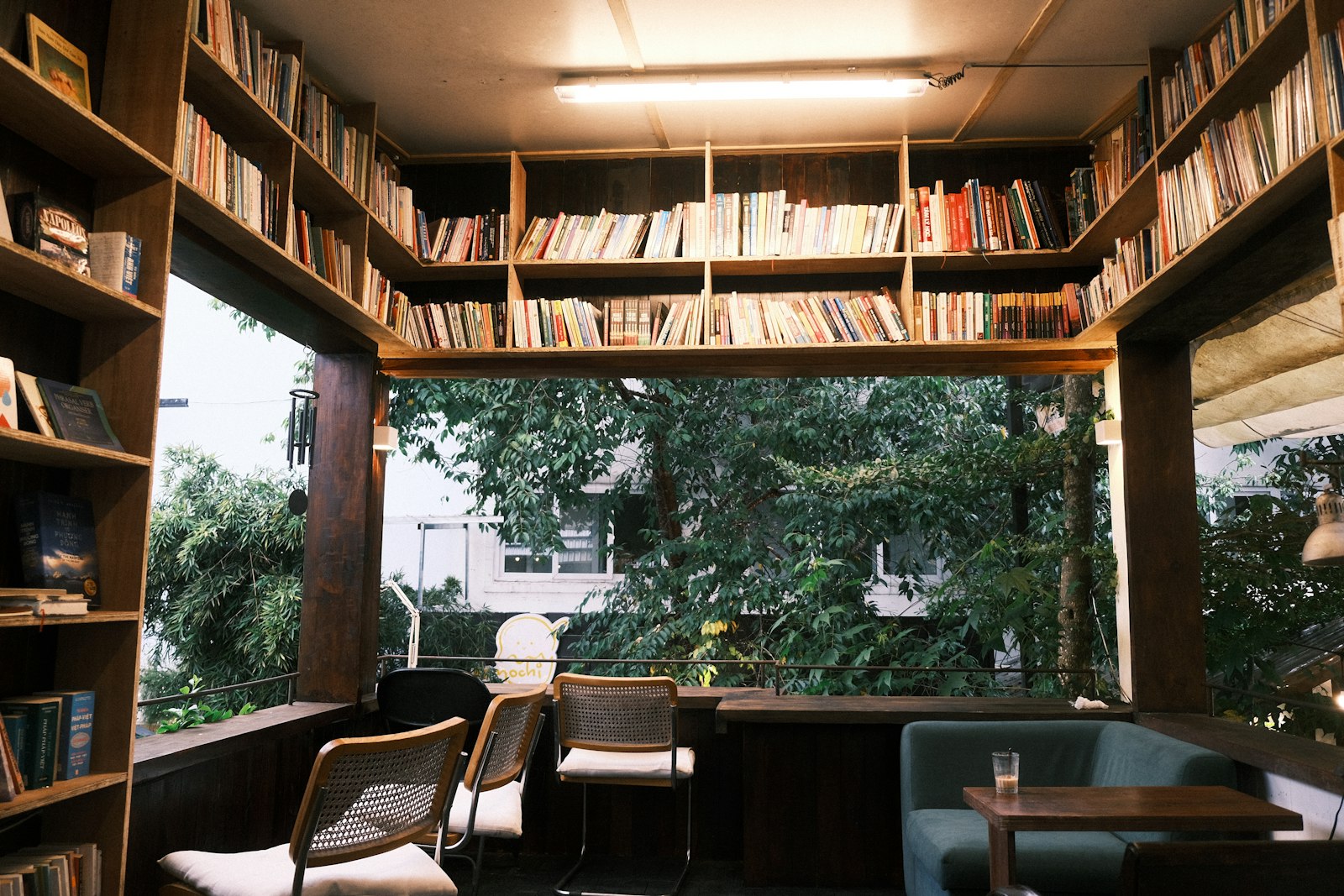
A cozy public-library reading corner, the kind of quiet shared room that becomes the second living room for serious readers

I had not been to a public library in six years because I had convinced myself that the library was a slower, more frustrating version of a bookstore. The library, in my mental model, was the place you went when you could not afford to buy the book. The library was for people who did not have credit cards. The library was a backup.
I was wrong about most of this. The library is, in 2026, a better system for serious readers than any personal collection can be. Here is what I had forgotten.
The library has more books than I will ever own. My local branch has roughly 38,000 items. The interlibrary loan system can pull from a regional collection of more than 1.2 million titles. My four hundred books are a rounding error. The library is not a smaller version of my bookshelf. My bookshelf is a much smaller version of the library.
The library acquires aggressively. The branch buys new releases within weeks of publication. The librarians I have talked to take patron requests seriously. If I want a book that the branch does not have, I can request it and it usually arrives within a month. The library is not behind the curve. The library is faster than I am at knowing what I want to read.
The library lets me quit. This is the underrated feature. When I borrow a book from the library, I have three weeks to read it. If the book is not working, I return it. I do not have to feel guilty. I do not have to put it on a "to read" shelf. I do not have to move it to my next apartment. The book goes back to the library and someone else gets a turn.
This last feature has been the most important for me. The sunk cost of an unread book on my shelf is enormous. I have spent, conservatively, $5,000 on books I never read. Every one of those books sits in my apartment, generating a small ongoing psychological tax. The tax is the feeling that I should finish the book because I paid for it. The tax is the feeling that the book is judging me from the shelf. The tax is the worry that I will one day want to read it and not be able to find it.
The library eliminates the tax. The book is borrowed. The book is due. The book goes back. The decision to stop reading it is a normal administrative decision, not a moral failing.
The library has librarians. I had forgotten that librarians are professionals with expertise. The librarian at my local branch knows the collection. She has read a lot of the books. She has recommendations that are better than most of the recommendations I was getting from the algorithm. She is also not trying to sell me anything. Her incentive is for me to enjoy the book. The incentive structure is different from a bookstore clerk's. The recommendation is more honest.
The library is free. This is obvious and I am embarrassed to admit it had stopped registering. I was paying $20 to $30 per new hardcover at the bookstore. I was paying $8 to $15 per used paperback at the Strand. I was paying $12.99 per Kindle book. I was paying, in total, somewhere between $1,200 and $1,800 per year on books I was reading at maybe a 60 percent completion rate. The library is free. The library was free the entire time.
What I did with the four hundred books I already owned
Stopping the bleeding was step one. Cleaning up the existing collection was step two.
I took two weekends in May 2025 and pulled every book off the shelves. I sorted them into four piles.
Pile one: books I had read and would reread. These were the keepers. There were about 90 of them. They went back on the main shelves.
Pile two: books I had not read but genuinely wanted to read. These were the books I had been carrying around with the intention of reading. There were about 60 of them. They went into a single small bookshelf in the living room, with the explicit agreement that I would either read them in 2026 or pass them on. No more moving them from apartment to apartment.
Pile three: books I had not read and no longer wanted to read. These were the books I had bought out of obligation, identity, or impulse. There were about 220 of them. They went to a used bookstore that gave me store credit. The store credit has since been spent on three replacements: a new coffee maker, a better desk lamp, and a paperback I am planning to return to the library after I finish it.
Pile four: books that did not fit the above. These were reference books, cookbooks, and a few rare things I want to keep for sentimental reasons. They went to a specific smaller shelf.
The four hundred books became ninety plus sixty plus the smaller shelf. The rest of the apartment opened up. The bookcase I had been using for the overflow is now a plant stand.
The act of sorting was its own kind of clarity. I had a much better sense, after the two weekends, of what kind of reader I actually am. I am a person who rereads a small core of books, who picks up new books based on mood and not on obligation, and who does not need a physical library to feel like a serious reader. The four hundred books were a performance. The ninety plus sixty is more honest.
How I read more now than when I was buying
The counterintuitive result of going back to the library is that I read more than I did when I was buying books. The number is not close.
In 2024, when I was still buying, I read 23 books. In 2025, after six months of library use, I read 41. The 2026 count is on pace for about 50.
The reasons are simple but I had not seen them until I stopped buying.
I am no longer optimizing for the next book. When I was buying, every finished book triggered an immediate search for the next one. The search was its own entertainment. The search took time. The book that resulted from the search was often chosen because it was available, not because it was what I wanted. I was consuming the discovery process as much as I was consuming the books.
The library forces a constraint. When I borrow a book, I have three weeks. The constraint means I sit down with the book the day I borrow it, not six months from now. The constraint means I do not start a new book until I have finished the borrowed one. The constraint means I read more deliberately than I did when books were sitting on my shelf waiting for me.
I am not curating as I read. When I owned a book, I was subconsciously thinking about how it fit on the shelf. Did it look good next to the other books? Did it match the aesthetic of the rest of the collection? The thinking took up mental bandwidth that should have been on the book itself. When the book is borrowed, the question of how it fits on the shelf is moot. The book is mine for three weeks. The book goes back. The reading is the point.
The library has events and recommendations. My branch runs a monthly fiction discussion group, a quarterly poetry series, and an annual staff picks display. The events have introduced me to writers I would not have found on my own. The writers have been, on average, better fits for my taste than the algorithm recommendations that drove my previous buying. The library is a discovery engine. The library is also a social space. The combination is hard to replicate at home.
What I have changed my mind about
The part of this experiment that surprised me the most is the number of opinions I had to revise.
I used to think that owning a book was the only way to take it seriously. I now think the opposite. Owning a book is a way of postponing engagement with it. The borrowed book is the book you actually have to read. The owned book is the book you can always get to later. Later, in my experience, never came.
I used to think the library was for people who could not afford to buy books. I now think the library is for people who want to read more than they want to perform reading. The performance of reading — the bookshelf as decor, the to-be-read pile as identity — was a significant chunk of why I was not actually reading.
I used to think my personal library reflected who I was as a reader. It did not. It reflected who I was as a consumer of recommendations from podcasts, algorithms, and bookstore clerks. The two are different people. The library reflects who I am at the moment I check the book out. The library is a more honest mirror.
I used to think the sunk cost of an unread book was a small thing. It is not. It is a constant, low-grade distraction. Every unread book on a shelf is a small unfinished project. The cumulative weight of a few hundred small unfinished projects is significant. The library eliminates the weight. The library is, in a way, a form of mental hygiene.
I used to think borrowing a book was somehow less committed than owning one. I now think the opposite. Borrowing is more committed. The borrowed book has to be returned. The borrowed book has to be finished, or deliberately abandoned, in a defined window. The owned book can be ignored indefinitely. The borrowed book cannot.
The honest summary
I am not going to pretend I will never buy a book again. I bought two books this year: a paperback of a novel I had already borrowed from the library twice and wanted to mark up, and a hardcover of an essay collection by a writer I am studying. The two were deliberate. The two are on the small bookshelf, not the main one.
For the rest, the library is the system. The library is faster, cheaper, lower-pressure, and better-curated than my buying habit ever was. The four hundred books were a problem I had been ignoring. The library is the solution I had been ignoring.
If you have a shelf of unread books and a library card you have not used in years, the math is similar. Walk in. Get a card. Borrow the book you have been thinking about. If it is not the book for you, bring it back in three weeks. The library is not a downgrade from buying. The library is the original reading system. The library was here before bookstores. The library will be here after bookstores. The library was, in retrospect, always the better deal.