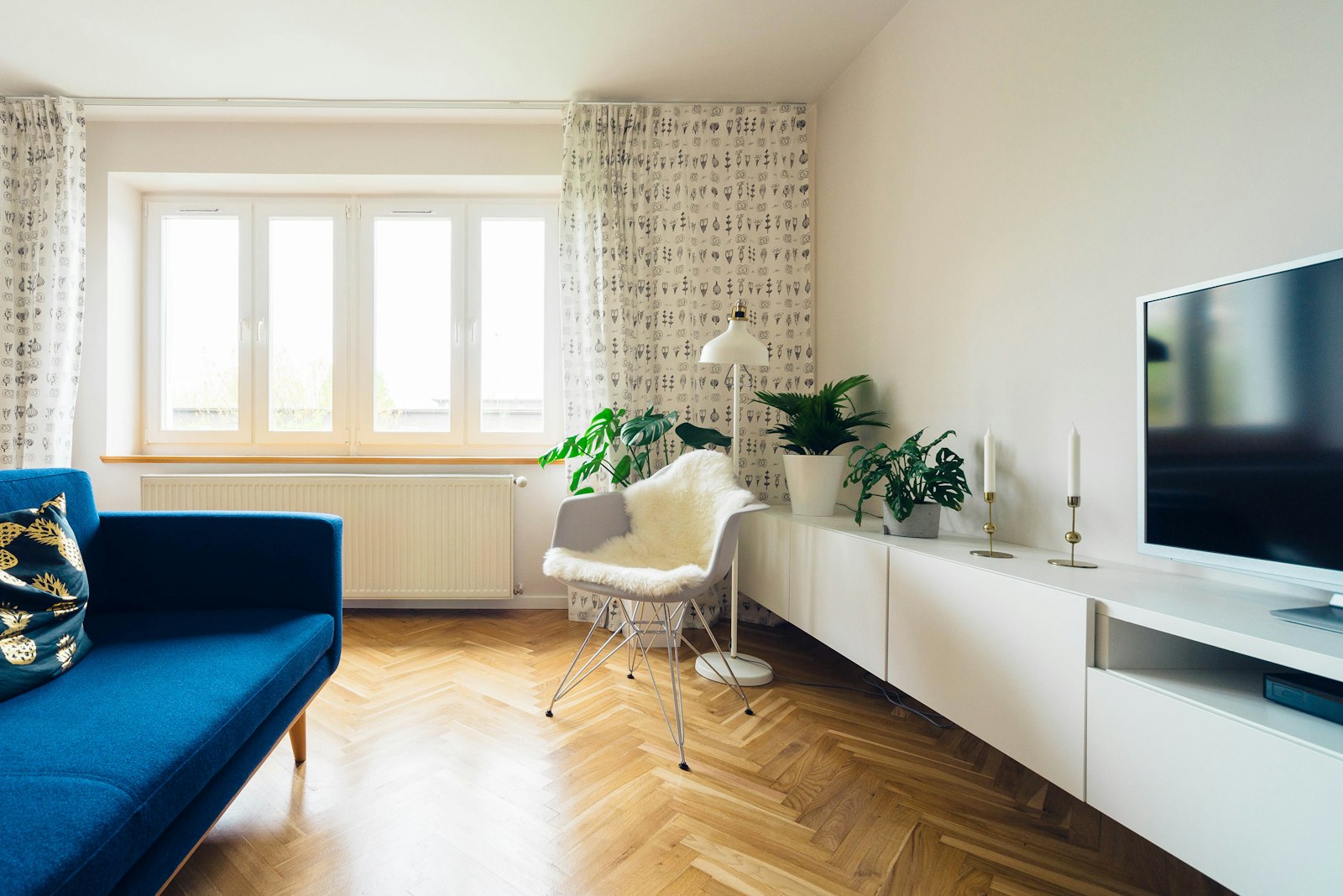
Most small-space design advice assumes ownership. It assumes you can paint, drill, change the hardware, knock down a wall. Renters do not have those options, which is why most renter-apartment photos look like either an institutional beige or a maximalist Pinterest board with nowhere to put anything.
The renter's challenge is to make a space feel intentional without making any permanent changes. That is harder than it sounds, but it is very doable with a few constraints.
The subtraction principle
The biggest small-space mistake is too much furniture. Most small apartments have a default furniture layout from the previous tenant — sofa against the longest wall, bed under the window, desk in the corner. That layout is rarely the best one for the actual space.
The first exercise is to take a photo of the room empty, or as empty as possible. Then look at it. The piece of furniture you keep out of habit is almost always the problem.
Common offenders:
- A sofa that is too large for the room. Replace with a two-seater or a deep armchair.
- A dining table for six when two people live there. Replace with a 90-cm round that fits flush against a wall.
- A TV stand that consumes an entire wall. Wall-mount the TV and lose the stand entirely.
- A bookshelf full of objects. Keep the shelf, halve the objects.
Subtraction, more than addition, is what makes small spaces feel larger.
The vertical principle
When floor space runs out, use the walls. Vertical storage is the most underused tool in renter design.
- Floor-to-ceiling bookshelves along one wall, mounted to the wall (no drilling required for tension rod systems)
- Hooks behind doors for coats, bags, towels
- Wall-mounted sconces instead of table or floor lamps, freeing up surfaces
- Magnetic strips in the kitchen for knives, spice tins, small tools
- Pegboards for tools, plants, kitchen utensils
Every surface you free up by going vertical is a surface that does not have to compete with your eye.
The light principle
Small apartments are usually light-poor. Most of the design work goes into making the existing light feel more abundant.
- Replace heavy curtains with sheer linen or unlined cotton
- Use mirrors on the wall opposite the largest window — they double the perceived light
- Choose lighter ceiling paint if you are allowed to paint (always ask)
- Use warm bulbs (2700K) at low levels in the evening, cool bulbs (4000K) at the desk or kitchen for task work
- Get rid of lampshades that block more than a third of the bulb
The metric that matters is not "how many lights" but "how many layers of light." A room with overhead light only feels flat. A room with ceiling, table, floor, and accent light feels like a place.
The pattern principle
A small space with no pattern looks institutional. A small space with too much pattern looks chaotic. The right answer is one or two strong patterns, used sparingly.
- One patterned textile — a rug, a curtain, a cushion — in a room of solid colors
- One patterned wall (peel-and-stick wallpaper is removable) behind a bed or sofa
- One patterned object — a vase, a tray, a piece of art — that anchors a surface
Avoid: matching sets (the bedroom set from the catalog), more than three patterns in any single view, large-scale florals in tight spaces (they shrink the room further).
The renter's version of "permanent" changes
Things that look like permanent changes but are not:
- Removable wallpaper (Command, Tempaper, similar brands). Holds for years, peels off cleanly.
- Peel-and-stick floor tiles for kitchen and bath. Not as durable as real tile but a major upgrade over builder-grade vinyl.
- Over-door hooks and organizers instead of drilling.
- Tension rods for curtains, room dividers, and closet shelves. Zero holes.
- Heavy furniture and rugs instead of wall fixtures. A large rug makes a room feel more designed than another painting would.
What to skip
- Furniture sets. They look like furniture sets.
- Trend-driven decor. Small spaces cannot absorb trend churn. Choose pieces you will live with for ten years.
- The "extra chair." Every extra chair in a small room is one less place to walk. Get rid of it.
- Decorative items that need dusting. Glass, ceramics, and open books accumulate dust. Closed storage is the renter's friend.
A small apartment designed with intention looks larger than a large apartment filled with things. The space itself does not change. The way you fill it does.